In nature, every body adapts to where it lives. A cheetah is fast because its life depends on speed. A mountain goat can stand on a cliff where we would fall, because that is its home. Birds are built for the air, fish for water, camels for the desert. Over time, an animal's body becomes an answer to the conditions it lives in.
Humans are no exception. Our muscles, posture, eyesight, metabolism and even our brain slowly change depending on where we spend most of our lives. So the question I keep coming back to is pretty simple: what am I making my body adapt to every day?
And for most of us, the honest answer is sitting. We sit when we study, we sit at work, we sit while we eat and we sit to relax. After a full day on the laptop we move to the couch and open Netflix, YouTube or TikTok, or just get stuck online again. The day is over, the brain is tired, there were a lot of tasks, and the body barely moved.
Not so long ago, by historical standards, movement was just part of ordinary life. People walked more, worked with their bodies, spent time outside, carried and lifted things and made things with their hands. In the evening they could sit down for a few hours and rest. Now it's the other way around. We're active for an hour or two a day and spend the rest of it sitting. The body adapts to that too, and not in a good way.
I started noticing this in myself and it honestly bothered me. I was slouching, I felt weak and stiff, I was losing shape and muscle tone, and I got tired faster. I knew the gym mattered, but in my last year of university I rarely had a stable time for it. Deadlines, work, classes, and a brain that was busy all the time. Some days were so packed that a proper workout just didn't happen.
So I decided to do the simplest thing possible and build movement right into my day. No waiting for the perfect time, for motivation, or for two free hours to appear. I would just get up between work blocks and do pushups.
At first it was chaotic. I'd be working on my laptop, then at some random moment I'd get up and do 10 or 20 pushups. Then the sets got bigger. Then I was doing around 100 a day. Later, once my body got used to it, I could get to 200 or even 300 a day. Over the year that added up to roughly 67,000 pushups.
Here is how it looked month by month in 2025. For the first half of the year I did 100 a day. In July it went up to 200, from August to November it was 300 a day, and in December I dropped back to 200.
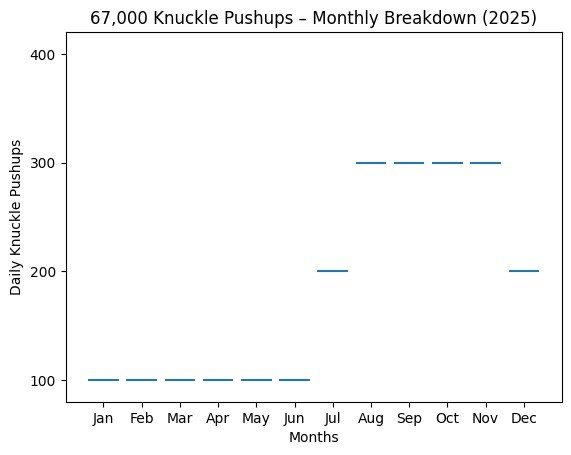
Still, I don't think the number is the interesting part. It only shows how many times I repeated the same thing. What I understood through all that repetition matters more to me.
I realized that the body changes when it regularly gets the signal to be active. Not once a week, and not only during a big session at the gym, but throughout the day. Going to the gym for two or three hours is obviously useful. But if you then spend the whole next day sitting, get mentally drained, watch shows in the evening and scroll the internet without really moving, your body still spends most of its time in a passive environment.
Pushups between tasks didn't turn me into a superhero. But they gave my body a different baseline. My muscles were engaged more often, my body felt stronger, and I felt less like just a head behind a laptop. I had the feeling that I was using my body again, not only my brain.
Then I started thinking about how to optimize it. Almost everyone knows Pomodoro: work for 25 minutes, rest for 5. It's a simple way to stop trying to hold your focus forever. The brain can't stay at maximum focus all the time. Working memory gets tired, attention drops, and after a short block of work a reset really helps.
The problem is that many people use those 5 minutes not as a reset but as another screen. You work on your laptop for 25 minutes, then pick up your phone. Then the laptop again, then the phone again. It feels like your brain is resting, but really it's just jumping from one digital stimulus to another.
So I came up with my own version. Let's call it the Kiyar Method. It's very simple: work for 25 minutes, do pushups for 5. Then another 25 minutes of work and another 5 minutes of pushups. After a few rounds like that you take a long break. Go out in the sun, take a walk, talk to someone, grab a snack, change your surroundings.
I'm not trying to turn every break into a hard workout. I just don't want to rest from one screen by staring at another. In those 5 minutes you give your body a clear signal to move. Wake up your muscles, get your heart rate up, loosen your shoulders, chest, arms and core. And remind yourself that you're not just a brain that produces text, code, ideas and decisions. You have a body too.
It works especially well when you're waiting for something. These days we spend more and more time waiting for ChatGPT or Claude to answer. You send a prompt, the model thinks, generates, writes. Usually that's when you reach for your phone or just stare at the screen. But you can do it differently: while you wait for ChatGPT or Claude to respond, do pushups. While the AI thinks, your body works.
It sounds a bit funny, but I think there's a strong idea in it. Modern life is full of tiny pauses: a file uploading, an answer generating, code building, a video exporting, waiting for a message, the gap between two tasks. Most people fill these pauses with scrolling. You can fill them with movement instead. Over a year, small choices like that turn into tens of thousands of reps.
I want to be honest here: a system like this doesn't replace the gym. If you want to build muscle, you still need heavy weights, progressive overload, a proper training program, good nutrition and recovery. Muscles need a strong mechanical stimulus. Hypertrophy doesn't come from doing light sets here and there during the day. To grow, muscles need a load they haven't adapted to yet, increased little by little. Pushups between study sessions won't replace bench press, squats, rows, pullups and real strength training.
The way I see it, the gym is the layer for strength, muscle growth and progress. Micro workouts are a maintenance layer. They're not there to replace training. They're there so your body doesn't spend the whole day switched off. It's a way to make up for something modern life took away from us: constant, natural movement. Or, put simply, the gym builds the body, and the small workouts keep it from forgetting that it's supposed to be alive.
One more important thing. You can't train the same muscle every day and call it a perfect system. I picked pushups because they're convenient. You can do them almost anywhere. You don't need a gym, equipment or any preparation. If there's a floor, you can start.
But pushups are mostly a push movement. They load your chest, triceps, shoulders and core. For a balanced body that's not enough. To make the system more complete, you need to add pulling, legs, mobility and cardio.
Pullups are the pull. They're important for your back, your posture and balance in your shoulders. Pushups push, pullups pull. Without the second one it's easy to end up with an imbalance.
Squats are for your legs: quads, glutes, hamstrings and core. These are big muscle groups that give the whole body a strong stimulus. You can't ignore your legs, especially if you sit all day.
Calves matter too. People often call them the second heart, because the calf muscles help blood return from your legs back up. When you sit for a long time, your legs become passive. Working your calves is a simple way to switch your lower body back on.
Stretching is for mobility. If you sit all day, your body doesn't just get weaker, it also gets tight. Your hips, upper back, shoulders and neck slowly adapt to the sitting position. That's why I see stretching not as an optional extra but as a way to compensate for your environment.
Running or walking gives you cardio, sunlight, fresh air, a change of scenery and a break for your brain. After a few work blocks, going outside for a walk can do more for you than another 20 minutes of staring at a screen.
So for me, pushups weren't the final system. They were the entry point. They showed me a principle: if an exercise is simple enough to do anywhere, it can become part of your day. And once it becomes part of your day, your body starts adapting to it.
While thinking about all this, I remembered One Punch Man. The main character did 100 pushups, 100 squats and 100 situps and ran 10 kilometers every day. Of course it's an anime, not a scientific training program. But I like the idea itself: a simple system you repeat every day.
I'd just make it more balanced. Not only pushups, but also pullups, squats, core, calves, stretching, walking or running. Not as a punishment and not as some extreme challenge, but as a daily way to keep your body in shape.
That's actually why I decided to build a website where you can log your workouts. To track not only big achievements but also small daily actions. Because what you log, you start to notice. And what you notice, you can improve.
Did pushups? Log it. Did pullups? Log it. Went for a run, did squats, stretched or trained your calves? Log that too. That's how movement turns into a system. You don't need to wait for the perfect Monday, the new year or a free month. You can start on any day with a small number of reps.
The main thing I took away from 67,000 pushups is this: your body doesn't adapt to your wishes, it adapts to your environment. If your environment is a chair, a screen, sitting still and scrolling, your body adapts to that. If you bring movement into that environment every day, your body adapts to that too. It just gets a different signal.
You don't have to start with 200 pushups a day, and you don't need to copy anyone else's numbers. You can start with 10. You can do one set between tasks. You can do a few pushups while you wait for ChatGPT or Claude to answer. You can get up after every work block and move for 5 minutes.
It won't replace the gym. But it can bring movement back to your body. And sometimes that's exactly where everything begins.